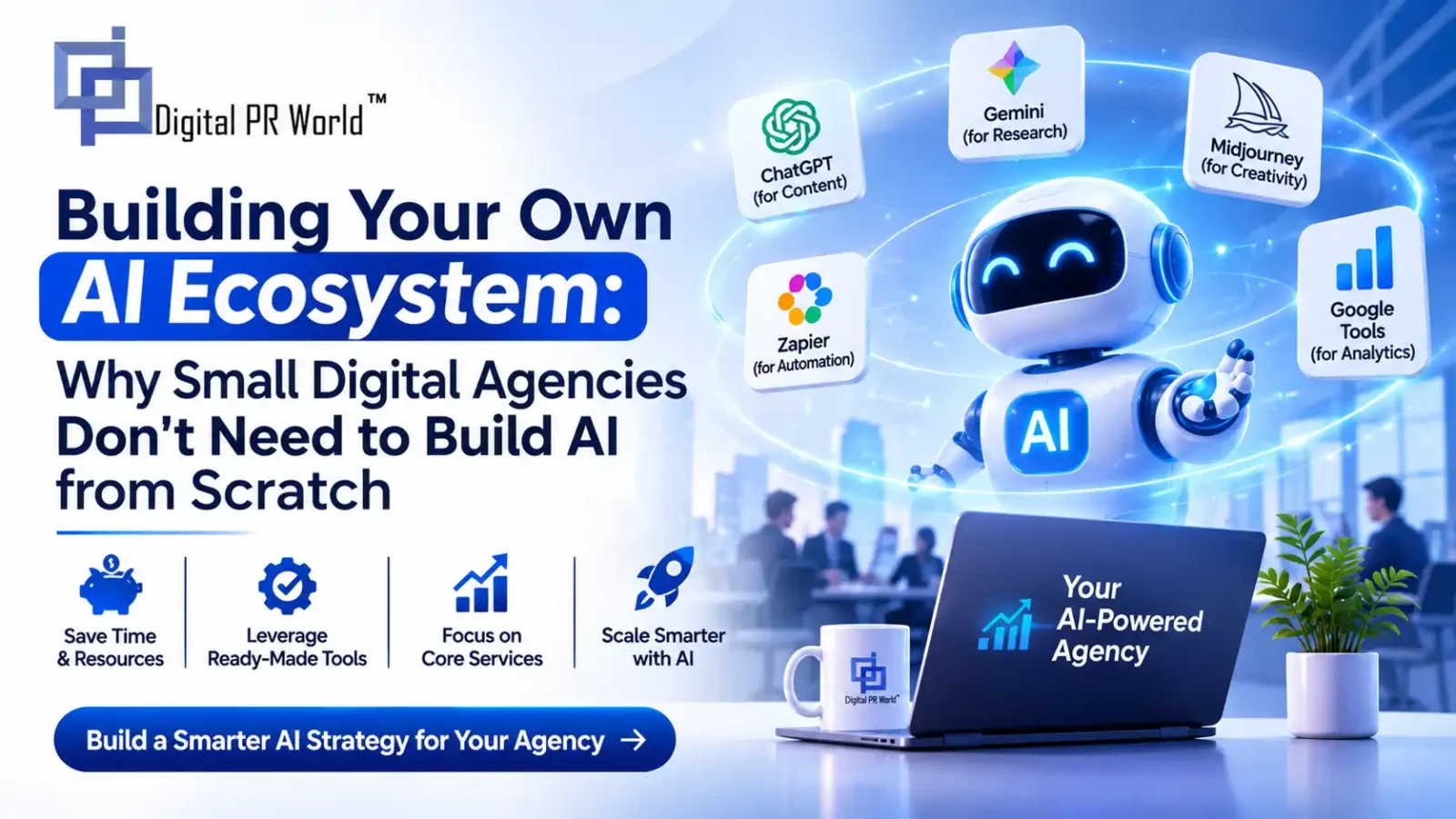
Artificial Intelligence is no longer a technology reserved for large enterprises with dedicated technology teams and substantial budgets. Today, small creative agencies, digital marketing companies, product-based businesses, and D2C brands can build their own AI ecosystems by combining existing AI tools, platforms, and automations. The objective is not necessarily to develop a new AI agent for every task. Instead, it is to create a connected working environment where AI can accelerate different aspects of business operations while humans remain in control.
At Digital PR World, we believe that the future of digital agencies is not just about adopting AI but about creating an AI ecosystem that works together.
What Is an AI Ecosystem?
Imagine an aircraft carrier moving through the ocean. It does not operate entirely on its own. It is supported by destroyers, frigates, submarines, AWACS aircraft, and other assets. Each component has a specific role, but together they form a coordinated ecosystem.
The same concept can be applied to AI in a digital agency or a D2C business.
An agency does not need one massive AI platform to manage everything. It can use different AI tools for content creation, keyword research, image generation, reporting, analytics, competitor analysis, and workflow automation. Each tool can perform a specific function, while the human team coordinates the entire process.
This is what we call an AI ecosystem.
Why Small Agencies Should Think Beyond Individual AI Tools
Many businesses begin their AI journey by using a chatbot to generate content or an image-generation tool to create creatives. Although these are useful applications, the real potential of AI emerges when multiple tools work as part of a structured workflow.
For example, a small digital agency managing SEO, social media, PR, and performance marketing campaigns can integrate AI into multiple stages of its operations:
- AI for keyword research and search intent analysis.
- AI for content planning and content creation.
- AI for image generation and creative communication.
- AI for SEO audits and technical analysis.
- AI for campaign reporting and performance interpretation.
- AI for competitor research and market analysis.
- AI for repetitive administrative tasks and workflow automation.
These tools do not necessarily need to be custom-developed. Several platforms already offer free and paid solutions that businesses can adopt according to their requirements and budgets.
Different Components of an AI Ecosystem
1. AI for Keyword Research and SEO Analysis
SEO remains an important growth channel for digital agencies and D2C brands. AI can help teams understand keyword opportunities, search intent, content gaps, and competitor strategies.
Tools such as Claude, ChatGPT, and other AI platforms can be used alongside data sources like Google Search Console, Google Analytics, and SEO research platforms.
For instance, an agency can use AI to interpret Search Console data, identify pages with declining performance, group keywords according to search intent, and suggest content improvement opportunities.
The AI platform provides analytical assistance, while the SEO specialist validates the findings and decides which recommendations should be implemented.
2. AI for Creative Communication and Image Generation
Creative agencies and D2C brands frequently require product images, social media creatives, advertising concepts, banners, and campaign visuals.
AI image-generation and editing tools can help reduce the time required to develop creative concepts and visual variations.
A small creative team can use AI to explore multiple campaign directions before finalizing a design. Product-based businesses can also use AI-assisted workflows for creative ideation, subject to product accuracy and brand guidelines.
However, AI-generated images must be carefully checked. Product packaging, labels, logos, text, and visual representations may contain errors. Human designers should review the final output before publication.
3. AI for Content Creation and Digital PR
Content creation is another area where an AI ecosystem can deliver considerable value.
AI tools can support:
- Blog topic ideation.
- Content outlines and editorial planning.
- Draft preparation.
- Press release structuring.
- Social media content variations.
- On-page SEO recommendations.
- Content repurposing across multiple platforms.
For Digital PR, AI can help teams organize research and develop initial drafts. However, factual verification, brand positioning, editorial judgment, and the final communication should remain with human professionals.
AI should assist the PR team rather than replace its understanding of the brand, audience, and media environment.
4. AI for Reporting and Performance Analytics
Reporting is often a time-consuming activity for small agencies. Campaign data may come from Google Analytics, Search Console, advertising platforms, ecommerce dashboards, and social media channels.
An AI ecosystem can help consolidate and interpret these datasets.
For example, AI-assisted reporting can identify:
- Changes in organic traffic.
- Improvements in keyword visibility.
- Campaign performance trends.
- Ecommerce sales patterns.
- Advertising performance variations.
- Areas requiring further investigation.
Tools that integrate with analytics platforms can make reporting more efficient. Claude, ChatGPT, spreadsheet-based AI features, and reporting automation platforms can be part of this process.
The objective is not simply to generate a report faster. It is to help the agency understand what the data means and what action should be taken next.
5. AI for Workflow Automation
Not every AI application needs to be an autonomous agent.
Businesses can use existing automations to connect their tools and reduce repetitive work. For example, a workflow could collect campaign data, prepare a draft report, notify a project manager, and organize the output for review.
Some automations may be available directly within software platforms, while others can be created using tools such as Zapier, Make, or similar workflow automation solutions.
Small agencies can begin with simple workflows and gradually expand their ecosystem as their operational requirements increase.
Human Intelligence Must Remain at the Centre
One of the biggest misconceptions about AI is that the entire process can be automated without human involvement.
In reality, AI tools can produce incorrect information, misunderstand context, generate inaccurate data interpretations, or create content that does not align with the brand.
Therefore, a practical AI ecosystem should follow a human-in-the-loop approach.
The AI tools perform specific tasks, while human professionals:
- Review and validate the outputs.
- Cross-check facts and data.
- Edit content and creative materials.
- Ensure brand consistency.
- Verify campaign recommendations.
- Approve final deliverables.
This approach helps businesses use AI more responsibly while maintaining the quality of their work.
Prompt Engineering: The Backbone of an Effective AI Ecosystem
The quality of AI output depends significantly on how the task is communicated.
A vague prompt may generate a generic result. A well-structured prompt containing the objective, context, audience, available data, constraints, and desired output can produce much more useful results.
For example, instead of asking AI to simply generate an SEO report, an agency can provide campaign objectives, keyword data, traffic figures, previous performance, and reporting requirements.
The AI can then be instructed to identify trends, highlight potential issues, and provide recommendations without inventing missing information.
Prompt development should therefore be treated as an important operational skill for agencies adopting AI.
Building an AI Ecosystem Within a Reasonable Budget
A small agency does not need to purchase every AI subscription available in the market.
It can begin with a few essential tools and expand gradually.
A practical approach could be:
- Phase 1: Identify repetitive tasks. Determine which activities consume the most time across SEO, creative, content, PR, reporting, and administration.
- Phase 2: Select appropriate tools. Evaluate existing free and paid AI platforms according to functionality, output quality, security, and budget.
- Phase 3: Connect workflows. Where appropriate, integrate tools with existing business systems and analytics platforms.
- Phase 4: Establish human review. Create clear processes for editing, fact-checking, and approving AI-generated outputs.
- Phase 5: Measure performance. Track whether the ecosystem reduces turnaround time, improves consistency, and supports better campaign decisions.
The ecosystem should evolve according to actual business requirements rather than the latest AI trends.
Conclusion: AI Is an Ecosystem, Not Just a Tool
For small digital agencies, creative companies, product businesses, and D2C brands, AI adoption should not be limited to purchasing a chatbot subscription or developing a custom AI agent.
The real opportunity lies in building a coordinated ecosystem of tools, automations, data sources, and human expertise.
Just as an aircraft carrier operates with a supporting fleet, a business can create a structured AI environment where each tool performs a specific function and contributes to the larger objective.
The future of digital agencies may not depend on who builds the most AI agents. It may depend on who can assemble the most effective AI ecosystem, operate it intelligently, and maintain the right balance between automation and human judgment.
At Digital PR World, we believe that AI should make businesses more efficient, creative, and competitive. Even a small agency with a limited budget can begin building its own AI ecosystem today — one tool, one workflow, and one improvement at a time.